
Audio bites
On the way, you listen to the lesson
Every finished lesson is recorded as an audio bite, in chapters, like a podcast. You can follow it without looking, and the controls show up wherever you already play audio.
Study with spaced review
Answers are everywhere. Making them stick is the hard part. Noesius turns your material into lessons, asks you right before you'd forget, and records what you can still explain months later.
Invite-only beta. If you have an invite, sign in at the top right.

What Noesius is
It turns your course syllabus and your material into a plan, lessons, audio and reviews, and keeps track of what you can already explain. The AI does the heavy lifting of organizing and writing; remembering and understanding stay yours, because that's where learning happens.
You walk into the exam, or the job, knowing it, without relearning it the night before.
You review what's starting to slip, not everything again. Effort goes where it's still needed.
You end up able to explain it in your own words and connect it to the rest, which is what a real exam asks for.
You see what you've mastered and what you haven't before the exam, without guessing or trusting the feeling of having read it.
Why asking a chatbot isn't enough
The effort of recalling and reasoning is what makes learning stick. Three recent studies show what happens when AI skips it, and what changes when it doesn't.
Nearly a thousand high school students practiced math with ChatGPT and did 17% worse on the exam without it. With an AI tutor that guided without giving the answer, that loss didn't show up.
91 university students researched the same question with ChatGPT or with a search engine. ChatGPT made it easier, but their arguments had less behind them.
Stadler, Bannert and Sailer, Computers in Human Behavior, 2024
Among 319 professionals who use AI at work, the more they trusted it, the less critical thinking they put into the task.
How it does this comes from decades of learning science: recalling without looking, spacing review, explaining in your own words. It's all in Why it works.
Where it fits
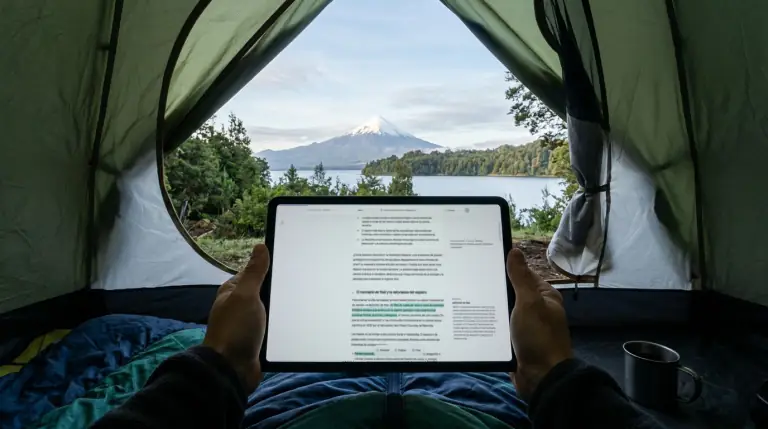
A lesson fits in a commute. A review fits in the wait for the train. What you study goes with you and waits where you left it.
Audio bites
Every finished lesson is recorded as an audio bite, in chapters, like a podcast. You can follow it without looking, and the controls show up wherever you already play audio.

Review
Questions come back right before you'd forget them. You answer in your own words, with no options to guess from. If it doesn't come, the concept returns sooner.
Lesson
Lessons come from your material and cite where each idea comes from. Highlight a sentence to define it, check it against your material, note it or ask about it.

Course
Each course shows its outline, the progress of every unit and what comes next. Dates and assessments come from the syllabus you uploaded.

Today
Today gathers what's due across all your courses, in order, and recalculates as you close each step. No deciding where to begin.
How it works
Here's how Noesius takes a microeconomics topic, price elasticity of demand, from the moment you upload your material to the point it's yours. Any other course works the same way.
Notes, chapters or handouts, as PDF, Word, PowerPoint or image. Dates and assessments come from the syllabus; you correct them if needed.
Five or six questions at once, ungraded, before the plan. You answer in your own words, and «I don't know» is one click away: it shows where to start and what doesn't need repeating.
If the price of gasoline goes up 10%, do people buy 10% less?
It starts from what you said you knew, comes from your chapter and cites the page. Five minutes to read; then you listen to it as an audio bite on the go.
Elasticity measures how much the quantity demanded reacts when the price changes. With few substitutes, people keep buying even when the price goes up: demand is inelastic, as with gasoline or medicine.
Your material · Ch. 5, p. 92When the lesson starts to slip, it comes back as a question. You answer first, in your own words, then compare. Get it right and it takes longer to return; miss it and it comes back sooner. Try it:
What you answer unaided at 7, 30 and 90 days is recorded with its date. What you missed isn't erased: it comes back sooner, and when you recover it, that's recorded too.
Only what you answered unaided, days later, counts. It downloads with its dates.
Why it works
Most of us study by rereading and highlighting, because it feels like progress. Learning science has spent decades measuring what actually sticks, and it's less comfortable. Noesius is built on four of its most solid findings.
Retrieval practice
Every time you pull something from memory without looking, that memory gets stronger. Reading it again barely does. In a classic experiment, people who tested themselves on a text remembered 61% of it a week later; those who reread it, 40%.
Every review asks for the answer before showing it, written in your own words. The tutor hands the question back instead of answering for you.
Same text, same study time; only how it was used changes.
Spaced practice
What you review in separate sessions lasts far longer than what you study all at once, and the best gap grows the longer you need to remember. It's one of the most replicated findings in psychology: one synthesis pooled 317 experiments.
It works out when each concept comes back: sooner if it was hard, later if you held on to it. You don't keep count or build decks.
Dots are reviews: further apart as long as you get them right. Illustrative example.
The illusion of knowing
A text you've already read reads smoothly, and that smoothness gets mistaken for mastery. A review of ten study techniques rated rereading, highlighting and summarizing as low utility. Practice testing and spaced practice were the only two rated high.
It doesn't count what you recognize as known: only what you answer unaided days later. That's why what's on record carries a date: 7, 30 and 90 days.
Dunlosky et al., Psychological Science in the Public Interest, 2013
Out of ten techniques reviewed. The rest were rated moderate or low.
Self-explanation
Saying why something is the way it is, in your own words, forces you to connect it to what you know and shows you where the gap is. Students asked to explain a text on the circulatory system to themselves as they read understood it better than those who only read it.
You answer by writing, not by picking an option. With “Explain” you say the lesson out loud to see if it holds, and the tutor asks about the step that's missing.
Chi et al., Cognitive Science, 1994
An asset is current because it will turn into cash within the year.
And what if the company is a vineyard, with an operating cycle longer than a year?
You answer first; then it explains whatever you need.
Everything points to one place: making what you study your own. You start by understanding, with lessons that build on what you already know. Then you put it to the test, recalling it without looking just as it starts to slip. Explaining it in your own words connects it to everything else. And with every round the reviews spread further apart, until it stops being something you recognize and becomes something you can explain, months later.
Who it is for
Noesius is for people who study with a syllabus, material and a deadline, and need what they learn to still be there afterwards. It works best when knowing something means being able to explain it: law, health, social sciences, humanities and the theory side of every other field.

Undergraduate, several subjects at once
Four subjects, three tests in the same month and notes spread over five folders.

Residency, final exam, certification
Months of study for a single day, and what came first cannot be gone when it arrives.

Master's, diploma, graduate school
You work, read at night and do not want what you already master explained again.

Continuing education, training, regulations
A new regulation or a certification to renew, between meetings and shifts.

High school, from age 14
Tests throughout the year and, later on, the university entrance exam.
Where it helps less. Solving exercises, calculating or coding isn't measured yet, though the theory behind them is. And it isn't for learning languages: its review is built for concepts, not vocabulary.
Questions
PDF, Word, PowerPoint, image or text: notes, chapters and handouts. The course syllabus as PDF, image or text. If something can't be read, you're told why.
They're written from your material and cite where each idea comes from. When you ask to go beyond the syllabus, the lesson flags it so you know what's on the test.
No. Its review is tuned for concepts, not vocabulary. It works best in law, health, social sciences, humanities and the theory side of other fields.
Nothing during the beta. Plans and prices will be published before sign-ups open.
Your material and lessons are yours: download them anytime, and deleting your account deletes everything. We don't sell or share data. Details are in the privacy policy.
Invite-only beta
Noesius is being tested with a small group of students. If you'd like to join the next one, tell us who you are and why you're interested. We read every request and will write to you when the next group opens.
Already have an invite?